Major environmental transformations rarely begin with bulldozers, ports, or heavy machinery; they begin much earlier, in discourses, campaigns, and narratives capable of redefining how we understand a territory and who the people are who defend it.
When environmental advocacy begins to challenge economic interests, not only do landscapes change, but the narrative itself also shifts, eroding democracy, freedom of expression, and the credibility of environmental defense.
Today, in various parts of the world, communities, Indigenous peoples, and defenders face an increasingly visible combination of disinformation campaigns, criminalization, and greenwashing strategies designed to minimize harm, discredit evidence, and portray environmental conflicts as obstacles to progress.
The year 2025 revealed alarming figures, as highlighted in the report by the Business and Human Rights Center, where Panama appears among the 10 countries with the most attacks against defenders who spoke out about risks and harms related to corporations.
Key Findings
In 2025, the Center for Business and Human Rights (Center for EDH) documented nearly 800 attacks (790) against human rights defenders in 80 countries who raised concerns about corporate actions. This represents more than two attacks on average per day and more than we have recorded in any single year since 2020. Almost a third of the attacks (30%) targeted Indigenous Peoples, who make up only 6% of the world’s population.
Attacks against human rights defenders who report on corporate-related harms and risks occurred in virtually every sector and region of the world. Latin America and the Caribbean accounted for the largest percentage of cases (42%), followed by Asia and the Pacific (30%).
Climate, land, and environmental defenders were the most affected: three out of four attacks (75%) targeted those protecting territories and ecosystems. In 2025, 53 human rights defenders were killed, and almost a third of them were Indigenous.
The most frequent attack mechanism was judicial harassment and criminalization, including strategic lawsuits against public participation (SLAPPs), which accounted for more than half of all registered cases (52%).
The sectors linked to the most attacks continued to be mining, fossil fuels, and agribusiness—industries historically associated with deforestation and socio-environmental conflicts. At the same time, attacks against individuals denouncing the link between arms companies and conflicts increased significantly, reflecting how struggles for human rights, land, and climate justice are increasingly interconnected.
The report highlights the case of the Puerto Barú project.
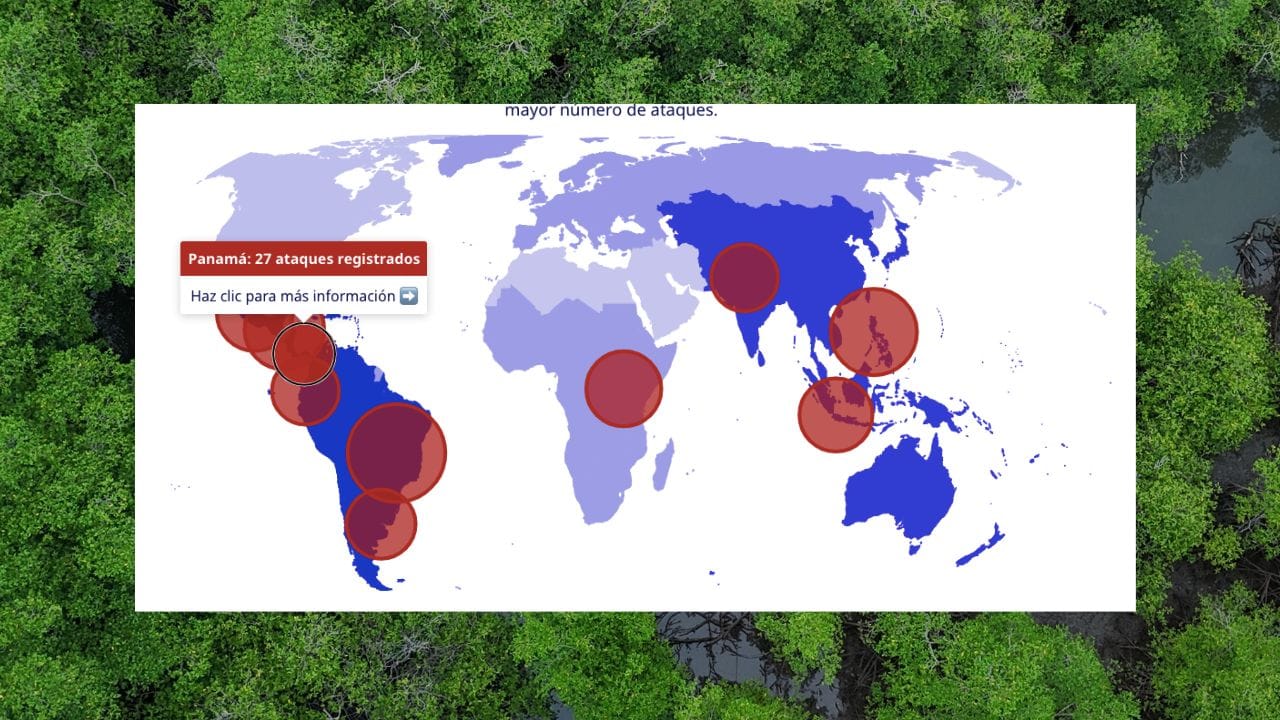
The report includes a map highlighting the locations with the highest number of attacks. Panama appears among these with 27 attacks, ranking tenth.

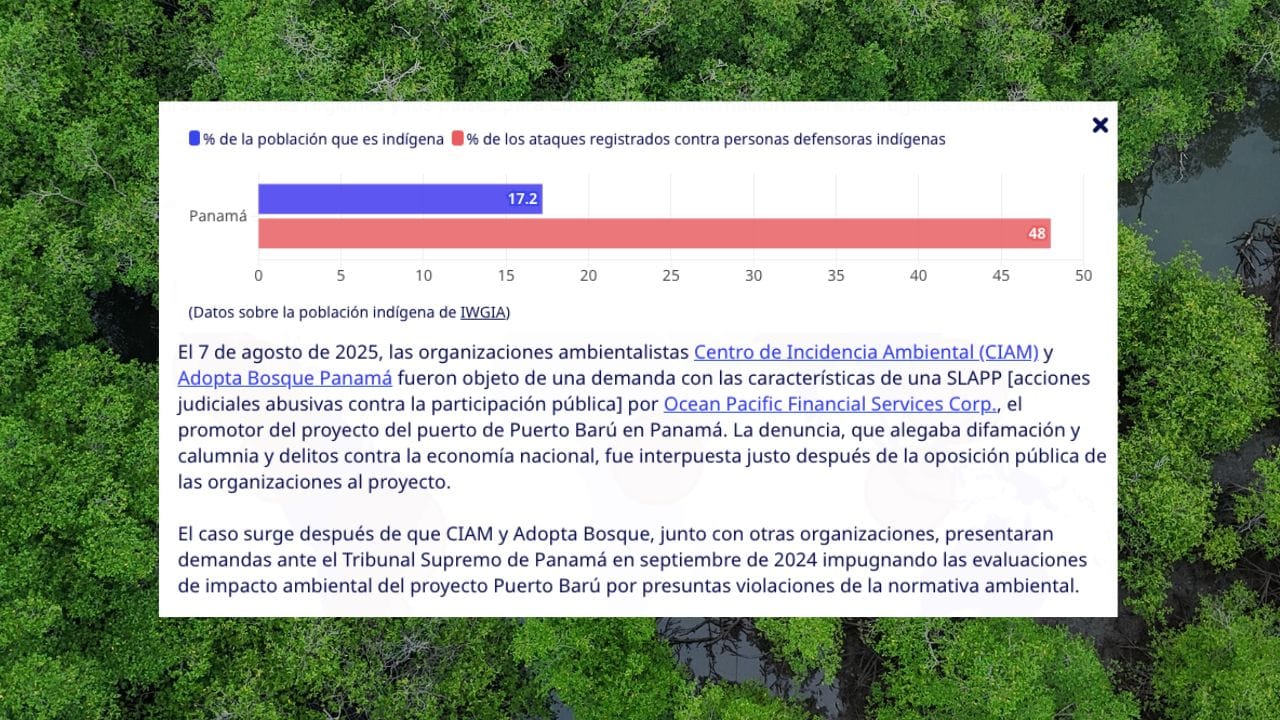
The Puerto Barú project is mentioned in a report that attacks the environmental organizations Centro de Incidencia Ambiental (CIAM) and Adopta Bosque Panamá, which were sued by Ocean Pacific Financial Services Corp., the developer of the Puerto Barú port project in Panama. The lawsuit, which alleged defamation, slander, and crimes against the national economy, was filed after the organizations publicly opposed the project.
The case arose after CIAM and Adopta Bosque, along with other organizations, filed lawsuits with the Supreme Court of Panama in September 2024 challenging the environmental impact assessments of the Puerto Barú project for alleged violations of environmental regulations.
Irresponsible business practices are at the heart of many of these dynamics. When companies fail to conduct robust human rights due diligence or adopt zero-tolerance commitments to attacks against human rights defenders, they increase their legal, financial, and reputational risks, fail to meet their responsibility to respect human rights, and can foster repressive environments.
The weaponization of technology against civic space
Technology is increasingly being used as a weapon to undermine democracy, shrink civic space, and silence human rights defenders. Global Witness, IM Defensoras, and others have documented the misuse of digital tools to intimidate, discredit, and criminalize those who report abuses and injustices.
Online smear campaigns have become a common tactic for undermining activists and social movements. In recent years, civil society organizations and groups have been publicly attacked through coordinated onslaughts on social media platforms.
This report demonstrates that when human rights defenders are attacked, not only is a voice silenced, but early warning systems are also weakened, and essential information for preventing harm, protecting territories, and anticipating risks that affect entire communities is lost.
Human rights defenders denounce abuses of power, identify threats before they occur, and are often the first to warn of impacts that are later confirmed by evidence. Their well-being and safety are deeply linked to the health of our democracies, economies, and ecosystems.
What is worrying is that today, threats transcend territories and extend into digital spaces, disinformation campaigns, legal proceedings, and narratives designed to discredit and isolate those who speak out.
Defending nature should never have become a risky activity, because when a society begins to punish those who warn of dangers, the problem ceases to be solely environmental and becomes a sign of the kind of future we are building.
Sources
Report Navigating a Global Crossroads: Human Rights Defenders and Businesses in 2025, Centre for Business and Human Rights





 EN
EN