

Who defends what makes Panama unique
Puerto Barú debates open environmental issues in Panama: dredging, doubts about water supply and legal proceedings against mangrove defenders.


The industry’s struggle for control of the narrative is a strategy to divert the focus from the environmental discussion in order to confuse and focus on disinformation; when the data is inconvenient, the focus is not on debating it in greater depth, but on weakening its impact on the public debate.
An example of this is when scientific evidence demonstrates significant risks or impacts; the response from certain sectors is not necessarily to review or adjust the projects. Often, the strategy is to sow doubt, discredit the source, and confuse public opinion.
This phenomenon is neither new nor isolated; it forms part of a global pattern that recurs in various environmental conflicts. In fact, strategic analyses of campaigns related to ecosystem protection explicitly recognize the presence of greenwashing as a systematic response to social pressure and scientific evidence.
One of the first strategies involves questioning the validity of the studies by suggesting that they don’t meet sufficient standards, that they don’t follow formal processes, or that they lack technical rigor. This type of argument doesn’t always aim to foster genuine scientific debate, but rather to generate uncertainty in public opinion.
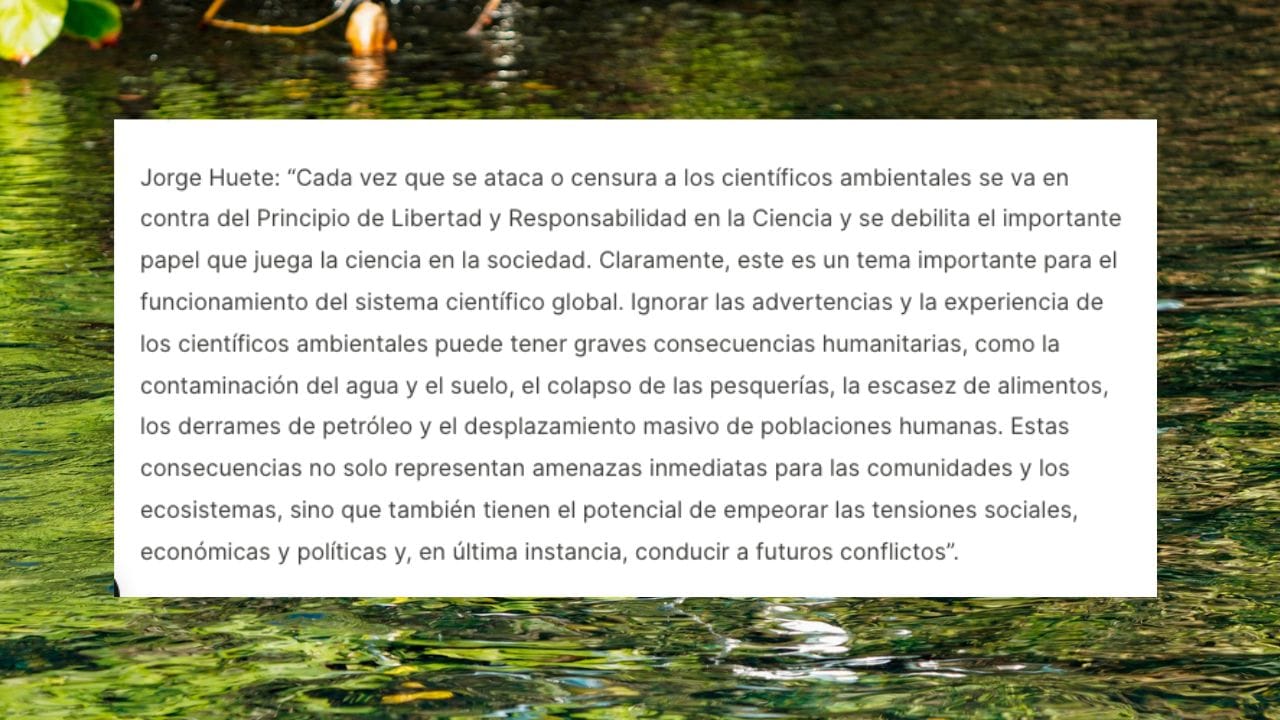
Artículo International Science Council
The International Science Council warns that these practices “undermine the integrity and credibility of environmental science, hinder its ability to inform policymaking and public discourse, and slow progress in solving urgent problems.” In this context, the problem is not merely technical, because when science loses legitimacy in the public sphere, decisions cease to be evidence-based and become more susceptible to economic or political interests.
When the evidence doesn’t favor certain interests, an alternative narrative is constructed where projects appear sustainable, impacts are minimized, and risks are presented as controlled. This phenomenon is widely known as greenwashing.
The goal is not necessarily to deny the problem, but to dilute it by presenting multiple versions of the same reality, fostering the idea that there is no single clear truth, only equivalent interpretations. However, in environmental matters, not all claims are equally supported.
For example, independent research has shown that ecosystems like those in the Gulf of Chiriquí are highly sensitive to interventions such as dredging or increased maritime traffic. These activities can significantly alter habitats and affect species that depend on them for survival, as is the case with dolphin populations in the area. The scientific evidence exists; what changes is how it is presented or questioned.
To understand why these strategies are repeated, it is necessary to look at the broader context. Since the Industrial Revolution, a way of thinking has taken hold that prioritizes capital accumulation over ecosystem conservation. Within this framework, nature is understood primarily as a resource available for exploitation.
This logic explains why, even in the face of solid evidence of environmental impacts, projects continue to move forward. The challenge is not only technical or environmental, but structural. When the economy becomes the absolute priority, nature conservation is perceived as an obstacle.
In this scenario, disinformation, the discrediting of science, and greenwashing are not anomalies, but rather tools that allow this model to be sustained. They are mechanisms that facilitate the continuity of projects that would otherwise face greater public resistance.
The problem, then, is not only environmental, but also institutional and social. When science is systematically questioned, when critical voices are discredited, and when information is fragmented into contradictory versions, a society’s capacity to make informed decisions is weakened.
Beyond any specific project, what is at stake is the way truth is constructed in the public sphere, and in that context, the key question is not just what is happening, but why there is an attempt to create confusion around it.
Because when the evidence becomes uncomfortable, what follows is not always an argument; often, it’s a strategy.
Source: International Science Council“Attacks on environmental scientists: implications for the free and responsible practice of science


 EN
EN