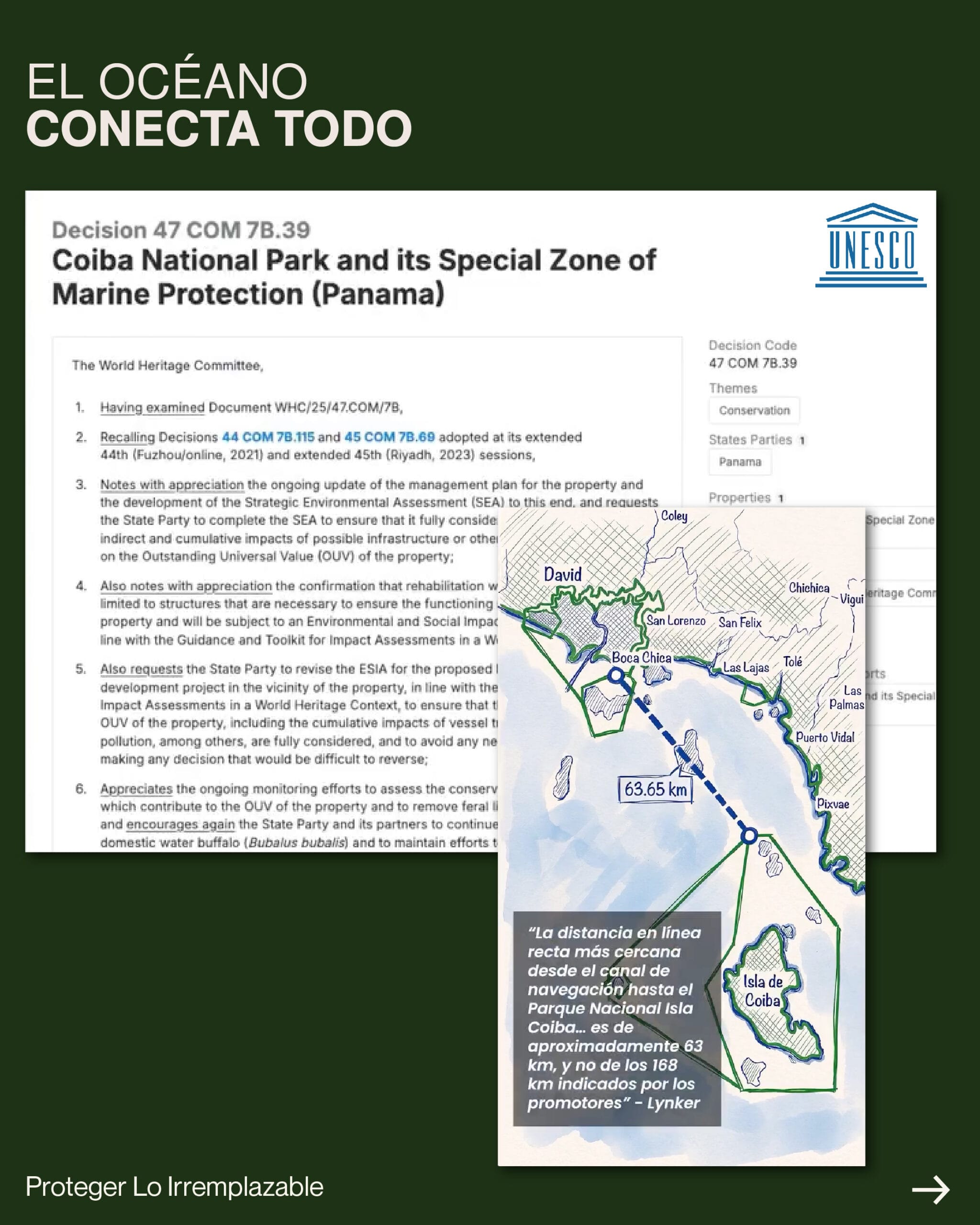
This is no longer just a local discussion; Panama is under international scrutiny. Coiba National Park, one of the most valuable marine ecosystems on the planet, has returned to the spotlight of the World Heritage Committee. And in that review, the name of Puerto Barú has surfaced.
When local becomes global
The stakes are high; the Panamanian government has been asked to re-evaluate the project’s environmental impact study, considering potential effects on the protected area. The concern is clear: the sediment generated by the dredging could drift out to sea and approach Coiba Island.
This is not an isolated hypothesis; it is supported by independent technical analyses that have cast doubt on the project’s actual effects. Panama now has a deadline to respond internationally, and the world is watching.

Voices that cross borders
Faced with this scenario, voices from different countries have begun to raise their voices.
Clara Tomé, an environmental and climate activist from Spain, poses a key question:
«What good is recognizing the rights of nature when these are violated as soon as there are economic interests involved?»
From Colombia, actress Ana Wills connects this moment with a story that seems to be repeating itself: “Today, history is repeating itself, while the planet burns, we continue to put the irreplaceable at risk.”
From a scientific perspective, Peruvian researcher Dr. Rosa Vásquez Espinoza warns
“The scientific evidence is clear: activities such as dredging remove sediment from the seabed, altering water quality, ecological cycles, and the habitats of multiple species.”
Panama also raises its voice; communicator and activist Camila Aybar points out
“In Panama, the largest mangrove forest in Latin America could be at risk.”
Kevin Gómez, from SOA Panamá, recalls the essential point: “When a place is a Natural World Heritage Site, its value is so great that it belongs to everyone.”
World Heritage: A Shared Responsibility
Coiba is not just any place; it has been a UNESCO World Heritage Site since 2005. It is a unique ecosystem, a key corridor for migratory species, and a living system that sustains biodiversity on a global scale.
When a place receives this recognition, it’s not an award, it’s a commitment. It means its value is so extraordinary that it belongs to all of humanity. And protecting it is not optional, but a shared responsibility.
Natural heritage is not just a landscape; it is the future, it is inheritance. It is what we receive without having created it, what sustains our history and our possibility of existence—it is our responsibility.
Natural heritage is life organized in balance: oceans that breathe, forests that regulate the climate, mangroves that protect communities; it is the invisible infrastructure of the planet.
What’s at stake
When an ecosystem is affected, it’s not just territory that is lost. Ecological cycles are disrupted, life networks are weakened, and the balance that sustains communities, biodiversity, and climate is compromised.
Ecosystems are not isolated; they are connected by currents, migratory species, and invisible processes that sustain life. When one weakens, the entire system feels it.
Today, the action is ours.
The stakes are enormous. And we still have time.
Sign the petition to protect Panama’s mangroves.
Share this information and amplify these voices.
Defending the mangroves is defending a heritage that belongs to everyone.
Protecting our heritage means defending the future by protecting the mangroves of David and Coiba, a World Heritage Site.
Act now, sign the petition




 EN
EN