This is an international call that Panama cannot ignore; more than a minor warning, it is a direct appeal from one of the world’s leading conservation organizations.
UNESCO has urged the Panamanian government to review the Environmental Impact Assessment (EIA) for the Puerto Barú project, given the risk that its impacts will not be limited to the local area, but will extend out to sea and reach one of the planet’s most valuable ecosystems, Coiba National Park, a UNESCO World Heritage Site.
What UNESCO warns is that the impacts do not affect just one ecosystem
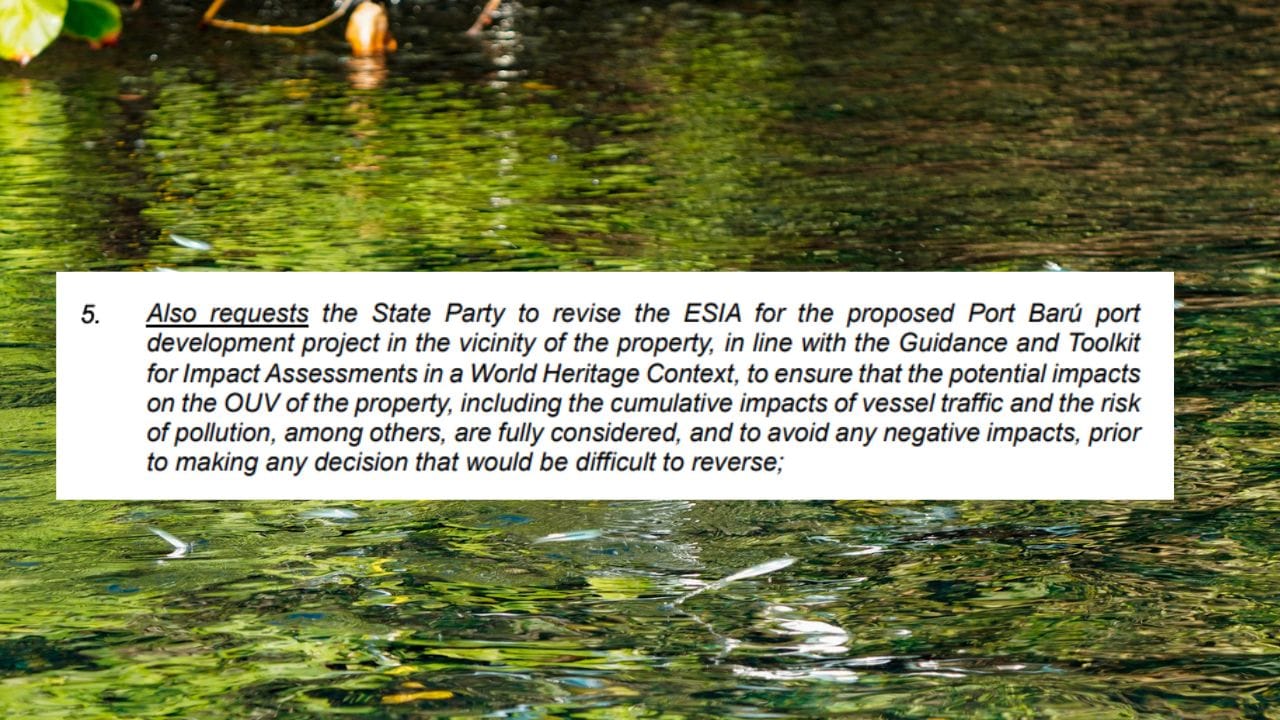
In its official decision (see page 138 and following), UNESCO places at the center a key concern: the indirect effects of the Puerto Barú project in Chiriquí have not been sufficiently evaluated.

Source: UNESCO State of conservation of properties WHC/25/47.COM/7B, p. 47 inscribed on the World Heritage List
In particular, the risk of sediment dispersal resulting from dredging is a critical point, because in interconnected marine systems, what is removed in one place can travel kilometers driven by ocean currents.
Scientific evidence had already warned of this
This risk is not hypothetical; it has already been documented in the independent Lynker technical analysis, which indicates that the dredging necessary for Puerto Barú could remove sediments, which can be dispersed through ocean currents.
UNESCO’s preparatory documents (see page 45 of the technical document) reinforce this concern: cumulative and long-distance impacts have not been sufficiently considered.
This reveals a structural flaw in the EIA, which assessed the project as if the ecosystem were static, but the ocean is not. Currents connect mangroves, bays, reefs, and protected areas in a single ecological network.
The importance of Coiba
Coiba National Park is not just a protected area in Panama; it is a heritage site for all of humanity. Its value lies in its biodiversity, its reefs, its role as a refuge for species, and its connection to coastal ecosystems.
When UNESCO intervenes, it does so because what is at risk transcends borders, because impacting Coiba is not a local loss, it is a global loss. UNESCO’s warning raises an inevitable question: Can a project proceed when its impacts could extend beyond what has been assessed, affecting a site of outstanding universal value?
When an international body requests a review of a project due to its potential impacts on a World Heritage Site, it is an opportunity to correct course before the damage becomes irreversible.
Source
UNESCO (2024), World Heritage Committee Decision, Coiba National Park (p. 138+)
UNESCO Decision 47 COM 7B.39
Lynker (2024).Independent Evaluation of the Puerto Barú Project, Technical report, December 6, 2024, p. 9.





 EN
EN