In Panama, the debate is not about whether to have a port; it is about where and at what cost. Because when there is a technically viable alternative, with better natural access, less need for dredging, greater expansion capacity and less environmental risk, insisting on building while affecting a sensitive ecosystem ceases to be a technical decision and becomes stubbornness.
That is precisely what the independent technical report prepared by Lynker: Panama. An alternative to Puerto Barú: Puerto Armuelles, which leaves many more than clear conclusions, where Puerto Armuelles presents suitable conditions for a multipurpose port, with lower environmental risks and greater expansion capacity than Puerto Barú. The report highlights advantages in bathymetry, road access, operational location, and natural protection against waves. (Executive Summary, p. 1; Conclusion, p. 16)
Puerto Armuelles has advantages over Puerto Baru
Lynker notes that, based on a preliminary analysis of bathymetry, oceanographic conditions, accessibility, and potential environmental impact, Puerto Armuelles has advantages over Puerto Barú: access to deep waters, a freight route connection to the Pan-American Highway, and unrestricted growth potential, far from sensitive ecological habitats and protected areas. (Executive Summary, p. 1)
This is not a minor detail; it means the discussion isn’t simply about whether Panama needs infrastructure. It means that, yes, there is another option, and that this option was already identified in a technical analysis.
Natural deep waters, without the dredging that Puerto Barú needs
One of the most important findings of the report is in the bathymetry. Lynker explains thatPuerto Armuelles has easy access to deep waters close to the coast, with depths that exceed -12 m MLWS required by the Puerto Barú project. This would significantly reduce or even eliminate the need for costly capital and maintenance dredging. (Executive Summary, p. 1; Section 4.1 Bathymetry, p. 9)
In contrast, the executive summary itself warns thatPuerto Barú would require extensive dredging of the navigation channel, with higher costs and greater environmental risks, including sediment dispersal and disruption of the David mangrove habitat. (Executive Summary, p. 1)
Less impact on mangroves and sensitive ecosystems
The report is also explicit in its comparison of environmental risks. According to Lynker, avoiding intensive dredging of Puerto Barú not only reduces costs but also prevents impacts associated with sediment dispersal and mangrove habitat alteration in David. The document concludes that Puerto Armuelles has lower environmental risks and that its deep waters minimize potential impacts on sensitive ecosystems. (Executive Summary, p. 1; Conclusion, p. 16)
This is crucial in a territory where mangroves are not an obstacle to development, but rather a living infrastructure, representing a refuge for biodiversity, supporting fisheries, acting as a natural barrier against extreme events, and serving as one of the most efficient carbon sequestration systems on the planet. The economic impact study of Puerto Barú reminds us that mangroves can store up to four times more carbon than other tropical forests. (CSF, section 1.2, p. 7)
Improved road access and use of existing infrastructure
Another strength of Puerto Armuelles is its connectivity. Lynker identifies two viable access routes to the Pan-American Highway for freight transport: an existing road of 37.1 km towards Paso Canoas, and an alternative route of 30.7 km, which could be developed to avoid urban intersections and minimize local impacts. (Executive Summary, p. 1; Section 2.0 Site Access, p. 3)
This matters because a serious alternative can’t just focus on the environmental aspect: it must also be operationally feasible. And Lynker says precisely that: The nearby roads offer a loading route(Executive Summary, p. 1)
In line with that argument, the position being reinforced today by the public interest is simple: If there is already existing infrastructure and viable routes, there is no point in insisting on dredging a fragile ecosystem.
When an alternative exists, insisting on Puerto Barú is a whim.
A few kilometers away, Puerto Barú insists on rising up in an ecosystem that could affect protected mangroves, vital in the fight against climate change, which support emblematic species that are the livelihood of fishing communities.
The information gathered in the studies supporting this campaign points in the same direction. The project’s ecological summary warns that dredging and maritime traffic would affect mangroves, reefs, marine fauna, and ecosystem services. The study of dolphins in Bahía de los Muertos identified 209 dolphins, of which 53 were considered residents, and concluded that the area is an important foraging ground, with 65% of sightings associated with feeding. (Panacetacea)
Therefore, the discussion can no longer be framed as progress versus the environment. The real choice is different: progress based on evidence or whims that lead to harm.
Institutional support
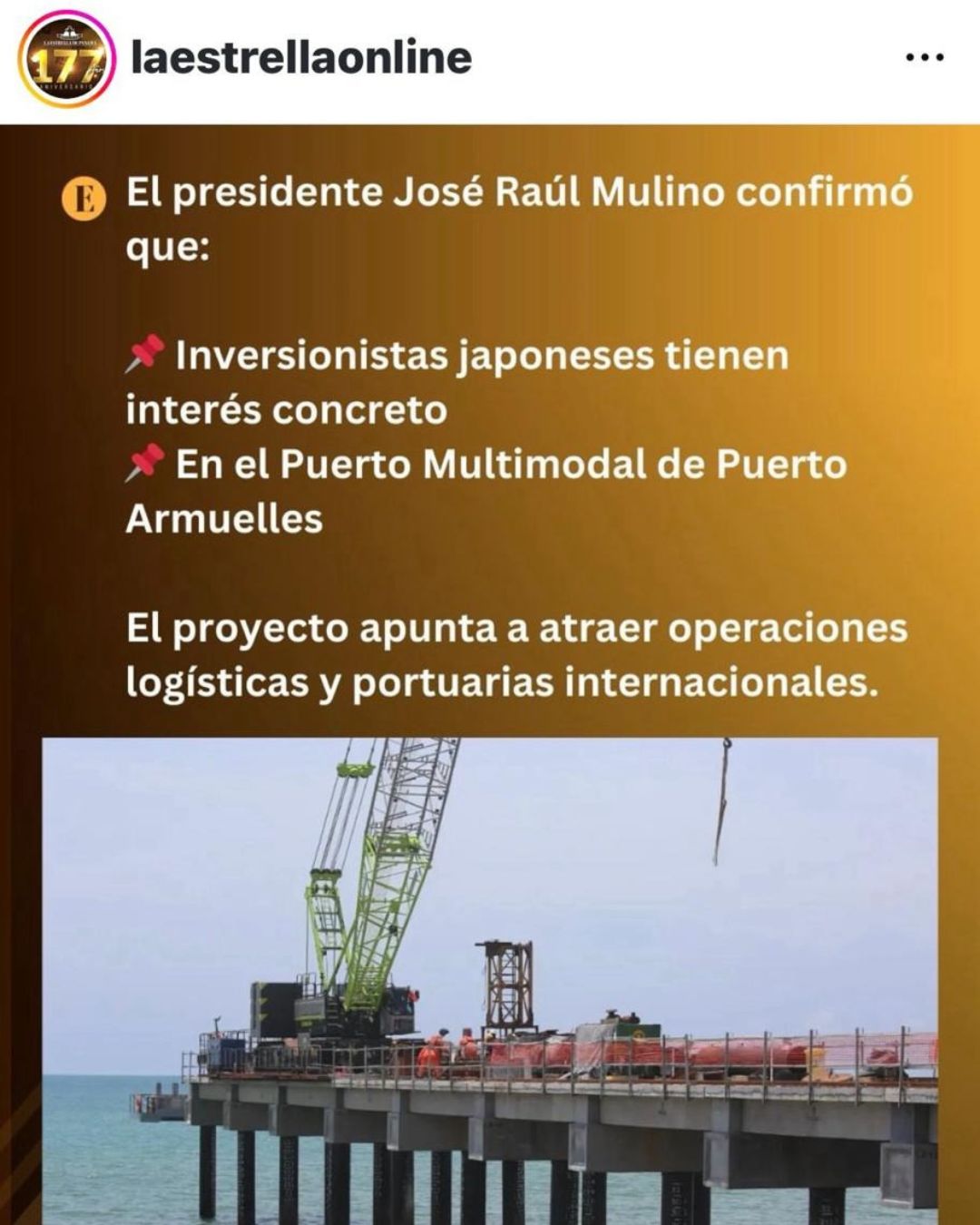
The government’s statements recognizing Puerto Armuelles as a priority logistics hub are well known.

Likewise, the maritime authority reaffirms this position.
So the question remains: Is Puerto Barú a whim? When there is a technically viable alternative, with natural deep waters, road access, the possibility of expansion and less ecological risk, insisting on Puerto Barú seems like an imposition.
Progress means protecting what gives us life.





 EN
EN