Panama City, Wednesday, December 11, 2024. No to Puerto Barú campaign leaders warned today that the Gulf of Chiriquí’s mangrove forests, fish stock, and coral reefs will be irreversibly damaged if the construction of the Puerto Barú project in David gets underway, according to an independent scientific report.
The Puerto Barú Environmental Impact Study (EIS) – approved by the last government – fails to spell out the true impact and risks to the delicate biodiversity of the West-Pacific region of Panama, according to the report by international consulting firm Lynker, a leading environmental modeling engineering firm, which also works as a contractor for the U.S. Federal Government.
The developers have repeatedly claimed that no mangroves will be affected by the construction of Puerto Barú. However, for the port to be viable, the project will require the dredging of parts of the navigation channel to reach a depth of up to 12 m. While dredging, fine sediment will be mobilized into the water column and transported by the rising tidal current towards the mangrove, trapping and suffocating mangrove roots, and disrupting seedlings by reducing penetration of light. Dredging will also increase water salinity in the estuary, which can disrupt the mangroves’ development, the life cycles of the marine species that hatch in them, and disturb other critical ecosystems nearby.
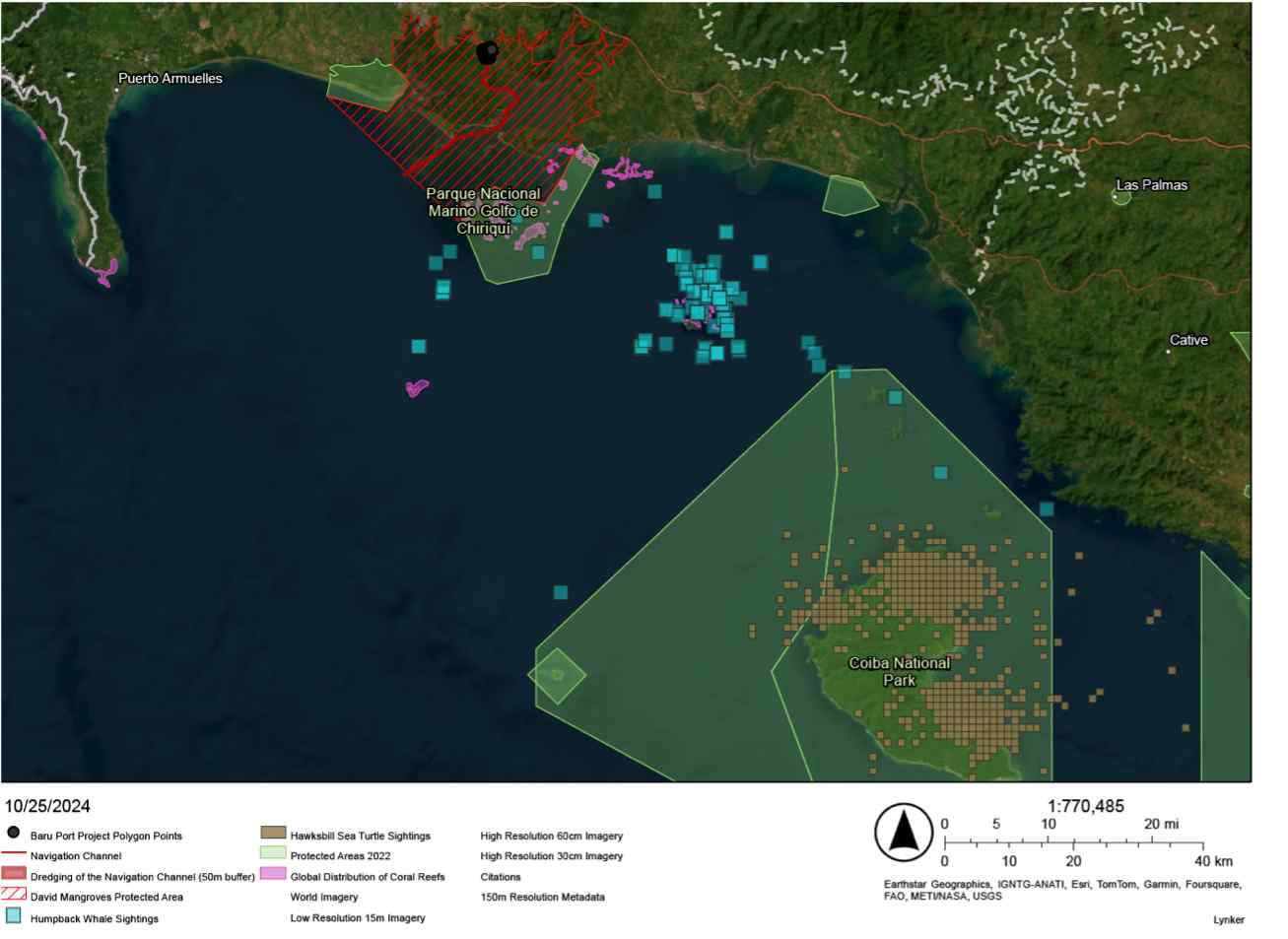
The proposed dredging would lead to 9 million m3 (the equivalent to 600,000 dump trucks of sediment) being removed from the seabed during the construction stage, and additional 800,000 m3 every two years thereafter. This sediment would be disposed at the mouth of the estuary, where the ebb tide would transport it to the calm waters of the Parque Nacional Golfo de Chiriquí, which is only 9 kilometers away, affecting coral reefs of great touristic and ecological importance.
Lynker’s analysis concludes that improper techniques were applied in the sediment dispersion and hydrodynamic modeling used in the EIS to assess the fate and transport of this disposed sediment. These findings cast doubt on the EIS’s conclusions regarding the minimal impact of dredging on mangroves and nearby protected areas. For reference, a recent dredging project in Miami, Florida saw 80 times more coral reef die than expected.
The mangroves also play a vital role in shielding communities from rising sea levels, floods, and storms. The communities around Puerto Barú are currently protected by the large mangrove forest, which acts as a natural flood defense from swells and storms. The construction and port operations threaten to damage these mangroves, making the communities around the port area more vulnerable to the impact of extreme weather events.
The protected mangroves are home to critically endangered species, such as the black-crowned central American squirrel monkey and hawksbill sea turtles, the most endangered sea turtle species in the world. Both species are decreasing in population, prompting countries and organizations to take measures to stop them from going extinct.
The area is also home to bottlenose dolphins, birds, monkeys, iguanas, fish, crustaceans and mollusks. Data also shows that large populations of humpback whales, Bryde’s whales, critically endangered Pacific smalltail sharks (Carcharhinus cerdale), inhabit the Gulf of Chiriquí, including in areas near the proposed navigation channel of the Puerto Barú project. There have also been numerous sightings of the endangered green sea turtle nearby.
For Dr. Julio Zyserman at Lynker, Puerto Barú’s EIS lacks sufficient evidence and underestimates the port’s potential impact.
“The developers’ EIS does not sufficiently consider the impact that the port construction, operations and dredging will have on critical ecosystems, something that is essential to any environmental evaluation. We have concerns about the methodology applied to the sediment transport modeling used in the EIS, and we have also found that there was an inadequate assessment of the impact of increased marine traffic on marine animals”, explained Zyserman.
Meanwhile, Guido Berguido, Biologist and Director of Adopta Bosque, one of the organizations opposing Puerto Barú in David, emphasized that the research from international consulting firm Lynker demonstrates why this port cannot be allowed in this location.
“We have always understood that Chiriquí needs a port; we are not disputing that. What we are questioning is why a port is being built on land that is surrounded by a protected mangrove area. We need development, but it shouldn’t have to cost the earth or biodiversity”, said Berguido.
For her part, Joana Abrego, Legal Manager at CIAM, said that Lynker’s investigation is proof that, if the Puerto Barú project in David is not stopped, one of the most precious mangrove forests in Central America could be destroyed forever.
“We have always known that the EIS did not robustly assess the impacts that the port will have on the protected areas and surrounding ecosystem. That is why we filed a lawsuit in the Supreme Court to have the Resolution that approved the EIS declared null and void. The true impact was not assessed by the previous government when approving it. It is urgent to re-evaluate the decision and relocate the port so that we can protect Panama’s mangroves for future generations” asserted Abrego.
The controversial Puerto Barú is proposed to be built 20 kilometers away from the city of David, in the province of Chiriquí, affecting a protected area that contains 25% of Panama’s mangrove surface.





 EN
EN