

Through the Mangroves of David, citizens head to the Court
163 citizens went to the Supreme Court of Justice of Panama to request the annulment of the EIA for Puerto Barú and precautionary measures for the Mangroves of David.


While Panama discusses the future of Managed Resources Area: Alanje, David and San Lorenzo Mangroves, two key concepts related to the project have also returned to the public debate. Puerto Barú in David: the Resolution No. 003-2024 and the Environmental Impact Assessment (EIA).
What is Resolution No. 003-2024?
The Resolution No. 003-2024 is the administrative act by which the Ministry of Environment approved the Environmental Impact Assessment (EIA) Category III of the project Puerto Barú in David.
Currently, this resolution forms part of the background of the legal proceedings that are still underway regarding the project.
It is important to note that Resolution No. 003-2024 does not correspond to the public consultation that MiAmbiente currently has open. These are different procedures, although both relate to the same territory: the David’s Mangroves.
What is an Environmental Impact Assessment (EIA)?
An Environmental Impact Assessment (EIA)It is a technical instrument that identifies, evaluates and proposes measures to prevent, mitigate or compensate for the possible environmental impacts of a project before its execution.
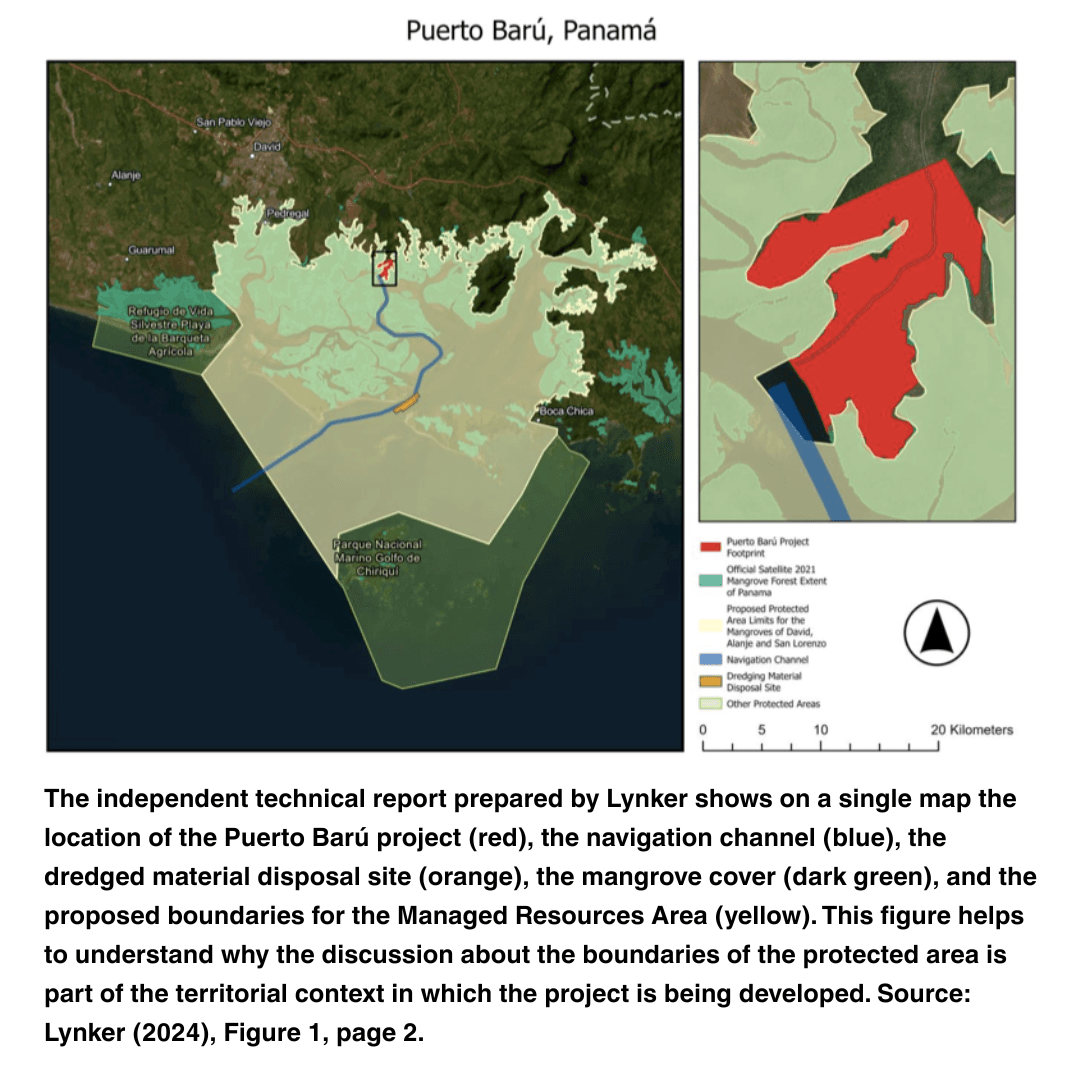
In the case of Barú Port in David the EIA was subsequently reviewed by independent specialists from Lynker (Technical analysis of the environmental impacts of the Puerto Barú port project, Panama) who identified important technical observations related to the assessment of impacts on mangroves, coral reefs, sediments, hydrology and marine biodiversity.
Why are we also talking about the boundaries of the protected area today?
While the debate continues on the Environmental Impact Assessment (EIA) of the Barú Port Project, The Ministry of Environment is maintaining an open public consultation on the proposal to delimit the Alanje, David and San Lorenzo Mangroves Managed Resources Area.
Various environmental organizations and citizens have submitted comments requesting that the proposal be strengthened, including explaining the reduction of the protected area, defining the buffer zones more clearly, and ensuring that the protection considers the integral functioning of the ecosystem.
So, what is being consulted today?
The public consultation currently open by the Ministry of Environment is a completely different process; its objective is to receive citizen comments on the proposal that defines the official boundaries of the Alanje, David and San Lorenzo Mangroves Managed Resources Area, one of the most important coastal ecosystems in Panama.
Several environmental organizations believe that this proposal can be strengthened to ensure more effective protection of the ecosystem.Among other observations, they have requested:
– an explanation of the criteria used to exclude certain areas;
– that exceptions be limited to activities that may affect the natural flow of water and the mangrove;
– that the buffer zone be clearly defined; and
– clarification of how this resolution will relate to previously authorized projects.
Why does it matter to understand this difference?
Because different processes are often confused, one thing is the Environmental Impact Assessment (EIA) and the Resolution No. 003-2024, which are part of the administrative process related to the project Puerto Barú.
Another different one is the public consultation whose purpose is to strengthen the protection of a natural area through citizen participation. Understanding this difference allows for more informed participation in a process that can define how one of Panama’s most important coastal ecosystems will be protected.
An opportunity to participate
Until August 14, any citizen can submit comments to the Ministry of the Environment. This public consultation is an opportunity to strengthen the proposal and contribute to the protection of one of Panama’s most important coastal ecosystems.


 EN
EN